Photobiomodulation is also known as Low-Level Laser Therapy, Laser Therapy, Cold Laser Therapy, or Red-Light Therapy.
As with the continual advancements in mobile technology, devices designed to deliver photobiomodulation for hair loss patients are also evolving. Photobiomodulation is a relatively recent medical term for a therapy I have provided since 1990:
PHOTO refers to light energy emitted from diodes,
BIO indicates biological tissue; in this context, the cells of hair follicles,
MODULATION denotes influencing these follicles to achieve beneficial clinical outcomes.
Early research established that these devices exert positive effects on hair follicles at a wavelength of around 650 nanometers, corresponding to the red-light range of the visible spectrum. More recently, a second wavelength near 808 nanometers (within the near-infrared range) has also demonstrated beneficial clinical results.
Can Light Grow Hair?
Light seems like an odd way to grow hair because “light” is all around us. If light grew hair, why would anyone have hair loss at all?
But light can help hair to grow, just under very specific circumstances, and it is helpful for regular patients to know how it works so that they can make prudent decisions with their doctors about whether this therapy can help their hair.
It turns out that light stimulates hair growth when specific wavelengths are exposed to hair-bearing skin at certain intervals and for specific periods of time [1]. It is also known that light therapy, although it can work by itself to grow hair, also helps other treatments (like minoxidil) work better, too [2,3]. And since light treatment has few if any side effects, light has the potential to be used to help hair loss patients around the world.
PhotoBioModulation (PBM) and Low Level Light Therapy (LLLT)
The two terms, PhotoBioModulation (PBM) and Low Level Light Therapy (LLLT), mean the same thing, but “photobiomodulation” is preferred, so that is the one we will use in this article [4]. The term photobiomodulation (abbreviated PBM or PBMT) was coined by Dr. Endre Mester in the 1960s when he observed light-induced hair growth on the shaved backs of mice. For the purposes of hair, we can also define the term DIRECT PhotoBioModulation (or dPBM) because the light needs to directly contact the tissue to work. Further experiments in humans revealed a host of other effects caused by light. For this reason, Dr. Mester is known as the “Father of Photobiomodulation”. [5]
If you think about it, the idea that light might be able to stimulate hair growth is not so strange. Light obviously affects human tissues and can alter the function of tissues. Easy examples include,
- Vision (light interacts with rod and cone cells of the retina),
- Tanning (sunburn!), Photoaging, and Skin Cancer
- Seasonal Affective Disorder (SAD), and
- Vitamin D production (or lack thereof, leading to Rickets), etc.
You would think that the opposite was true, but darkness doesn’t cause hair loss. When a patient starts to lose their hair, it is not due to a lack of light. But for whatever biological reason, hair cells have light receptors.
Oddly enough, hair cells have “smell” and “taste” receptors, too (and incidentally they “love” the smell of synthetic sandalwood! or at least it stimulates them…) [6,7]. Why these receptors exist, no one is sure, but we can potentially use them to our advantage when it comes to stimulating hair growth!
NOT ALL tissues respond to light! For a tissue to experience a biological change from light therapy, it must have a molecule that “accepts” the photons from light. “Photo-acceptors” exist in all sorts of tissues, from your eyes, blood vessels, and nerves, to skin and hair [8,9]. The tricky part turns out to be getting the photos to the receptor because sometimes these receptors are deep within a tissue.
What Light Does Hair Like?
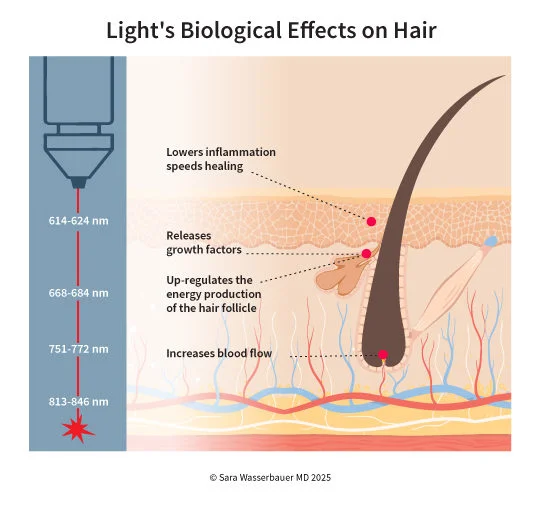
Like the proverbial toddler, hair is very “picky” about which light it likes. Happily, your hair has some choices. Hair likes light in the visible and “Near Infra-Red” (called NIR for short) part of the spectrum, and there is good data that hair likes light from one of these four ranges of wavelength. [1,10,11]
- 614-624 nm
- 668-684 nm
- 751-772 nm
- 813-846 nm
Once the photons are absorbed into the skin, they behave similarly, so it does not matter if the light comes from lasers or LEDs (as long as the wavelength is the right one). Note that this is different than initially thought when laser devices for hair growth were first invented. At that time, researchers were not sure if laser light was required or if any light source would do, and it turns out that both can work.
Some of these wavelength ranges have been specifically associated with hair growth (like 668-684nm) and some with wound healing/blood supply (813-846nm), but nearly all of them have the potential to be beneficial for hair. How can they all have the potential to help hair?
When light interacts with most tissues, it only responds when all the correct characteristics are present. You can think of this like a key fitting a lock. When everything is right, “CLICK!” the door opens, and things happen. With hair, there is a photoreceptor – likely at about the middle of the follicle where the “anatomical bulge” containing regenerative cells is located, so 668-684nm will work well to stimulate “cell proliferation.” It is thought that photons are accepted by the Cytochrome C oxidase in the mitochondria of these cells, and then, “CLICK” the lock opens, and these cells are stimulated to produce more hair.
But increasing the blood supply also works to help hair grow, so 830nm works, too! Another lock, another wavelength to open this special lock, and “CLICK,” now more blood supply is helping your follicles to get the oxygen and nutrients needed to grow a more robust hair. In other words, there are many potential ways for light to stimulate hair growth.
If this is getting confusing, think of the simplifying phrase: “wavelength = depth in tissue”. The deeper you need to go, the longer the wavelength you need. And, lucky for those of us wanting more luscious locks, hair has many potential targets.
The Specific “Photobiology” of Hair Growth
The tissue that grows hair is special. In other words, there are more of these “locks” along the way to growing nicer “locks” (pun intended). Here are a few that will help you understand how light grows hair optimally.
1. Biphasic Dose Response is the LAW
Hair seems to like not too much light (higher levels are inhibitory) and not too little light (lower levels are ineffective), which is a phenomenon that is named the “biphasic dose response”.
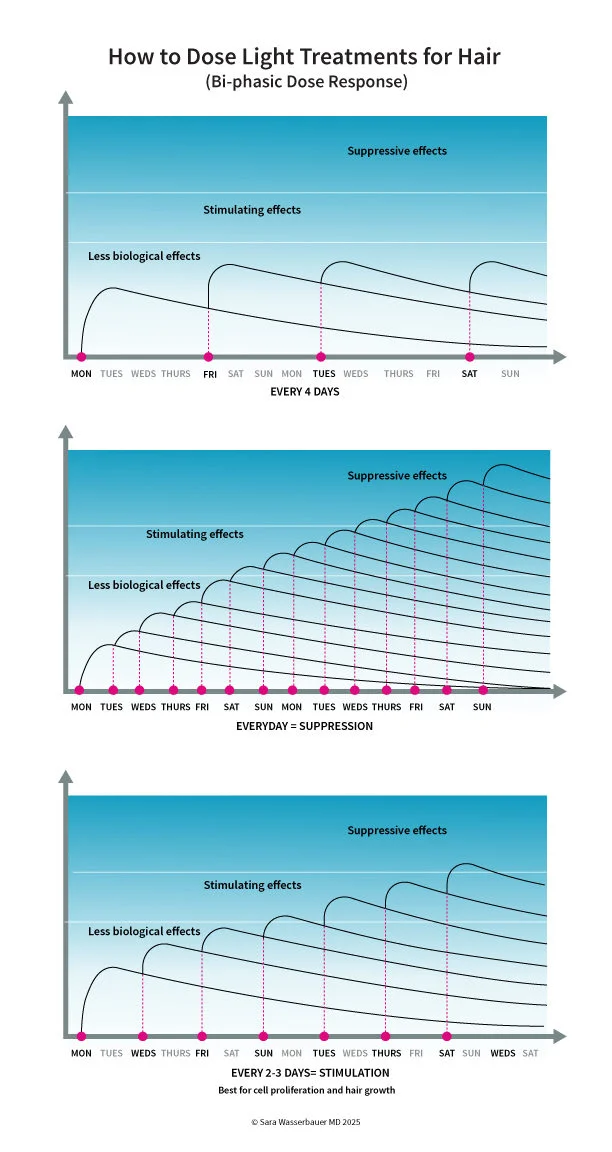
One can imagine light and resulting hair growth like the story of “Goldilocks and the Three Bears”, where only the middle dosing is “just right.” (pun again intended!). Exactly how much light each patient would need to grow hair might not be the same from person to person, but we know that treatment from some currently available consumer devices is likely inhibitory if it is used daily, while every second or third day is enough to be beneficial. [12,13,14]
This seems to indicate that the biological processes reacting to the light need time to happen. It makes sense. When hair grows, the regenerative cells within the follicle differentiate (i.e., become the cells that are needed) and proliferate (make copies of themselves). As anyone who has made a few dozen holiday cookies will tell you, it takes time to make all the cookies before the mixer and the oven can start again on a new batch. Your hair follicles are producing a desirable product for you, too, and they just need a little time to process the ingredients into the final form. [12]
2. Little Bit and Often is Best
For growth, hair likes to have light exposure to be a little bit and often. Generally, cell proliferation (i.e., growth of hair) is optimized with low doses over longer periods of time. [15,16]
Plus, scalp hair itself usually takes 11-12 months to respond to treatment and grow out fully. Think how exercise works best a little bit every other day, and how vitamins taken frequently (but not all at once) improve health. It is the same; hair growth stimulation from light works best when the patient is “patient!”.
3. Direct Contact is Optimal (Inverse Square Law)
Tissues where the photoreceptor is deep (like the scalp) like it best when the light source is placed in direct contact with the tissue (dPBM), and this is probably because more photons from the light get to their target. Without having a clear path to the scalp skin “target”, hair kind of “gets in its own way”. Furthermore, the color of the hair can reduce the transmission of light; even 2mm of hair (about 1/16 inch) reduces the transmission of light by 32-37% when comparing dark hair to lighter hair. [17] So when hair is present, and the light does not get to the target, growth will not happen.
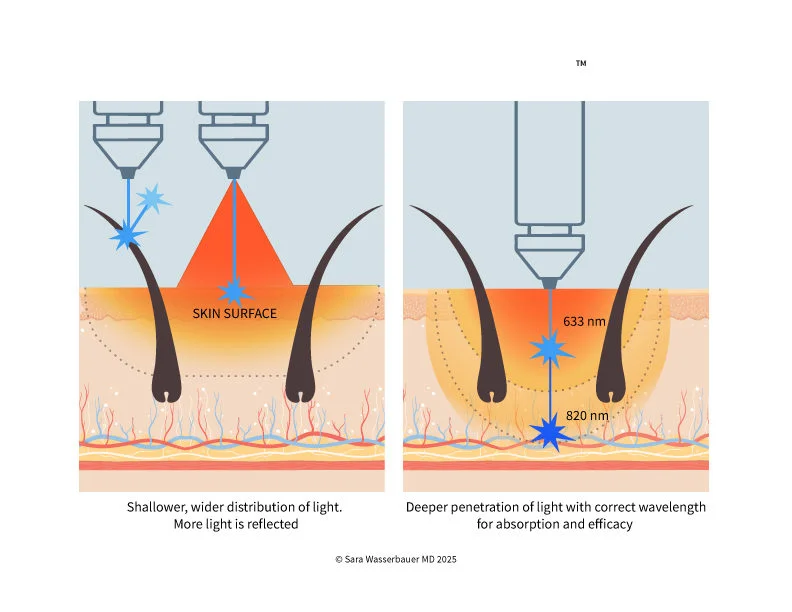
As a historical note, this is why laser light was useful in the first phototherapy devices, because laser light shoots straight, like a laser pointer, and could get through wet/combed hair. Scientists call lasers “columnated” light, and light like this is less likely to be scattered once it leaves the source, thus more likely to reach its target. Similarly, unless the source is touching the scalp, perpendicular light sources have a better chance of having the light enter the scalp, because the scalp is a curved surface and tends to reflect or scatter the photons.
However, now we know that once light enters the scalp, all the photons of the light head in all directions, so it is “non-coherent”, so how the light got there in the first place may be less important.
This is one of the chief paradoxes of using light for hair growth; the desired result (hair growth) interferes with the ongoing efficacy of the treatment unless the light has a path past the hair to the scalp. Hence, the term DIRECT PhotoBioModulation (dPBM) might be best for describing how light can stimulate hair growth.
4. Dark hair absorbs more than light hair
Another reason for variable responses among patients may be that the devices available to consumers to help grow hair are themselves variable (more on this later). Hair color also significantly affects light dosing because darker pigments absorb light energy more readily than blond or white. [17] Professionals seeking to improve hair growth may need to account for hair color with individualized light dose prescribing in future iterations of PBM treatment.
5. Dosing time
For light to reach the photoreceptor, it must be on the target tissue long enough. The optimal dosing time for a scalp is still in question. Initial research indicated 14-20 minutes would be necessary due to something called the “bleaching effect”, but that was with the light source in contact with the tissue surface, and in the case of the scalp, the presence of hair complicates the transmission of light in several ways. [12]
HISTORICAL and TECHNOLOGICAL EVOLUTION
During the late 1980s and early 1990s, the initial devices were large and resembled traditional salon hair dryers; patients were required to visit the office for approximately 40 appointments over a year-long protocol. Upon completion of treatment, patients typically concluded their sessions. After about 19 years of using these devices, advancements in technology led to the introduction of home-use models, which increased convenience for individuals undergoing laser therapy.
These continued to evolve:
- The initial unit was a small brush-shaped device with only nine to fifteen diodes, requiring half-hour treatments three times a week by passing it over the scalp.
- Cap-like devices were later developed, designed to deliver 30 minutes of pulsating laser energy every other day. These devices featured between 82 and 272 diodes (650nm).
- Over time, advancements in technology resulted in cap-like devices equipped with up to 312 diodes (650nm) that emitted non-pulsatile laser energy. These innovations enabled daily treatment sessions as brief as six minutes, offering a convenient means of ensuring adherence to effective therapy.
- The latest technological advancement is a cap device equipped with 320 diodes, delivering both 650nm and 808nm wavelengths for clinical efficacy. This device features an expanded therapeutic area due to its distinctive design, which extends deeply to the nape of the neck and laterally below the ears.
LONG-TERM CLINICAL OBSERVATIONS
For more than 35 years, I have utilized photobiomodulation to treat thousands of patients, consistently aiming for three primary clinical outcomes: stabilization of hair loss, promotion of hair regrowth, and accelerated healing or early regrowth following transplants. Through extensive experience, I have gained significant insight into the ways this therapy benefits individuals experiencing hair loss.
Stabilization of Hair Loss Progression (90%)
It is important for patients to identify and address the progression of miniaturization, shedding, and thinning early. My observations indicate that laser therapy provides treatment area coverage in 90% of patients.
Regrowth of Miniaturized Hair (60%)
Hair regrowth was observed in 60% of patients who experienced hair loss.
Post Hair Transplant Benefits
Over many years, I have consistently observed notable benefits of photobiomodulation in hair transplant patients. For all surgical cases, I administered office-based device treatments twice weekly for two weeks starting the day after surgery. The following outcomes were noted:
- A notable portion of hair in the transplanted grafts remained and started growing.
- Postoperative shock loss was reduced compared to usual cases.
- The initial regrowth of transplants was observed at week eight, rather than the typical three to four months.
Once cap-like devices became available, I would have them begin their home therapy on the first post-operative day and thereafter.
Additional Interesting Observations
- Unlike the other hair loss therapies that are used in non-surgical hair restoration, I have observed early on, and up to this day, that once low-level laser therapy is discontinued, only ten percent of patients would resume shedding of their hair. This shedding occurs in 100 percent of people who discontinue minoxidil, finasteride, dutasteride, and PRP.
- I have observed that the anti-inflammatory effects of red-light therapy clinically extend beyond its FDA clearance. Many patients have reported that their psoriasis, eczema, and lichen planopilaris symptoms and signs considerably improved while using it for their hair loss.
Common Questions About Light and Hair Growth:
How is light therapy from a laser going to grow hair when lasers REMOVE hair?
First, not all light therapy devices for hair growth use a laser since light from an LED source can create hair growth as well, particularly when the light reaches or is in contact with the tissue. Secondly, the targets and characteristics of the light are different. Lasers for hair removal have a different wavelength, pulse duration, and energy since they are targeting the pigment in the hair shaft. It is, as they say, like “comparing apples and oranges.” One is entirely unlike another, and both can be safe when used appropriately.
How do we know all this light will not cause cancer?
Light in the visible spectrum is non-ionizing, including near infra-red (NIR), used for most light therapy for hair growth. This means it does not have the energy to cause damage and is known to be safe with few, if any, side effects. “Ionizing radiation” is the type of light that causes damage to cells and DNA, and that is not produced with light therapy devices. [18]
What if I stare directly into the light of my light therapy device?
Most light devices have 5mW of energy output. Energy up to 100mW/cm2 is safe for the eyes, so it should be safe for a light device.19 One should use any light device within the parameters the manufacturer recommends.
What are the side effects of light therapy?
There do not seem to be significant adverse effects with photobiomodulation (low-level light therapy) treatments. Light therapy does improve wound healing of multiple types of tissue, in addition to reducing inflammation, swelling, and pain.
Can I use oral or topical hair loss medications at the same time as light treatments?
All oral and topical medications for hair loss can be used with photobiomodulation treatments. Low-level light may even have a synergistic effect with some medications like minoxidil or finasteride. [2,3]
Does light therapy help after a hair surgery?
Photobiomodulation Treatment (PBMT) is known to assist with wound healing by increasing the blood supply to the treated tissue. In fact, the wavelengths that do this are already known to be in the 813-846nm range. So, if the device itself does not physically dislodge the grafts or injure the donor area (which is unlikely with most devices anyway), PBM treatment should be helpful.
Does light therapy help when the hair loss is due to a different cause, like a scarring alopecia? Or alopecia areata?
Depending on the wavelength used in the photobiomodulation device, effects can be anti-inflammatory. Since the cause of both scarring alopecia and alopecia areata is inflammation along the hair follicle, photobiomodulation has significant promise as a treatment for these conditions. [20]
Which Device Will My Hair Like?
Light therapy holds promise for hair growth efficacy, and yet the optimal light therapy device and dosing regimen (also known as “dosimetry”) is not yet known. For hair growth to occur, the optimal device will have to fulfill several requirements of the physics of light (also known as “photonics”).
- It will have to get the light reliably to the scalp (i.e., PAST the hair), and while closer is better, contacting the tissue is best. [12]
- It will have to have a wavelength that stimulates the hair to grow (i.e., cell proliferation and growth factor release)
- It will have to be used on a specific schedule (i.e., not too often, and not too little)
- It will have the right dosing for hair. Note that this makes it difficult to compare, since light devices that provide the beam from afar cannot claim to have the same dosing (also known as irradiance, which is energy per square cm) as devices where the light beam touches or nearly touches the skin.
One of the first devices marketed for hair growth (FDA cleared in 1997), is still one of the few to address this issue by parting the hair with comb-like tines to let the light reach the target. Since then, light therapy devices for hair growth (and other uses) have proliferated, but nearly all rely on telling patients to wet the hair and part it for the light to reach the scalp.
It is rarely mentioned, but astute patients with darker skin tones have already figured out that different skin types may alter the dosing of light to make hair grow. Pigment absorbs light, whether it is in the hair or on the top of the skin. So, if a hair is like a tree in your “follicle forest” and the light is like water for that tree to grow, the pigment in the skin and in any hair in the way of the light will act like a sponge – keeping the photons from reaching that all-important root system where the cytochrome C photoreceptor waits! So, it is like a sponge stealing all the water from the tree. There is, as yet, no consumer light device for hair growth in patients with dark skin tones.
Take Home Message
Light therapy for hair growth is safe and effective. As with any medical treatment, some consumer devices will work better than others, and the science in this field has a long way to go to prove which dose is best for each patient. But given that photobiomodulation can work in synergy with all the other therapies out there for hair growth, including surgery, minoxidil, finasteride, and so on, it is a worthwhile consideration for our patients.
Photobiomodulation and its synonyms need to be broadcast to our patients as a medical, FDA-cleared, and scientific therapy with a very long clinical history to treat male and female pattern hair loss with NO side effects. One of its disadvantages is the fact that Big Pharma has not been involved in its inception and technological evolution to provide millions of dollars in research funding. However, small studies and the test of time have proven its effectiveness, and our patients have been the beneficiaries of its clinical rewards.
References
- Kim TH, Kim NJ, Youn JI. Evaluation of wavelength-dependent hair growth effects on low-level laser therapy: an experimental animal study. Lasers Med Sci. 2015 Aug;30(6):1703-9. doi: 10.1007/s10103-015-1775-9. Epub 2015 Jun 6. PMID: 26048721. https://www.ncbi.nlm.nih.gov/pubmed/26048721
- Esmat SM, Hegazy RA, Gawdat HI, Abdel Hay RM, Allam RS, El Naggar R, Moneib H. Low level light-minoxidil 5% combination versus either therapeutic modality alone in management of female patterned hair loss: A randomized controlled study. Lasers Surg Med. 2017 Nov;49(9):835-843. doi: 10.1002/lsm.22684. Epub 2017 May 10. PMID: 28489273.https://pubmed.ncbi.nlm.nih.gov/28489273/
- Liu, Y., Jiang, Ll., Liu, F. et al. Comparison of low-level light therapy and combination therapy of 5% minoxidil in the treatment of female pattern hair loss. Lasers Med Sci 36, 1085–1093 (2021). https://doi.org/10.1007/s10103-020-03157-1 , https://link.springer.com/article/10.1007/s10103-020-03157-1
- https://www.naalt.org, first consulted 1/22/24
- Mester A, Mester A. The History of Photobiomodulation: Endre Mester (1903-1984). Photomed Laser Surg. 2017 Aug;35(8):393-394. doi: 10.1089/pho.2017.4332. PMID: 28783466. https://pubmed.ncbi.nlm.nih.gov/28783466/
- Chéret, J., Bertolini, M., Ponce, L. et al. Olfactory receptor OR2AT4 regulates human hair growth. Nat Commun 9, 3624 (2018). https://doi.org/10.1038/s41467-018-05973-0 https://www.nature.com/articles/s41467-018-05973-0
- “The first law of photobiology states that for low power visible light to have any effect on a living biological system, the photons must be absorbed by electronic absorption bands belonging to some molecular chromophore or photoacceptor.” http://photobiology.info/Hamblin.html
- J.C. Sutherland, Biological effects of polychromatic light, Photochem Photobiol 76 (2002) 164-70.
- Hamblin, M.R. Mechanisms of laser induced hair regrowth. Source: Wellman Center for Photomedicine.biomediclaser.org. March/April 2006, pp. 28-33. Google Scholar
- Hamblin, M.R. Mechanisms of LLLT. 2008 (Aug). www.photobiology.info/Hamblin.html Google Scholar
- Hode, Lars, and Jan Tunér. Laser Phototherapy: Clinical Practice and Scientific Background : a Guide for Researchers, Doctors, Dentists, Veterinarians and Other Interested Parties Within the Medical Field. Prima Books, 2014.
- Huang, Y.Y., et al. Biphasic dose response in LLLT. Dose Response. 2009; 7(4):358-383. Google Scholar
- Chung, H., et al. The nuts and bolts of low-level laser (light) therapy. Ann Biomed Eng. 2012(Feb); 40(2):516-533. CrossRefPubMedGoogle Scholar
- T. Karu, Primary and secondary mechanisms of action of visible to near-IR radiation on cells, J Photochem Photobiol B 49 (1999) 1-17.
- R. Lubart, M. Eichler, R. Lavi, H. Friedman and A. Shainberg, Low-energy laser irradiation promotes cellular redox activity, Photomed Laser Surg 23 (2005) 3-9.
- Mustafa, F.H., M.S. Jaafar, and A. Ismail. Influence of hair color on photodynamic dose activation in PDT for scalp disease. IFMBE Proceedings. 2011; vol 35.Google Scholar
- University of Calgary. Laser Safety Manual, 2008. http://www.ucalgary.ca/safety/system/files/uofclasersafetymanual.pdf. Google Scholar
- Wikramanayake TC, Rodriguez R, Choudhary S et al (2012) Effects of the Lexington LaserComb on hair regrowth in the C3H/HeJ mouse model of alopecia areata. Lasers Med Sci 27(2):431–436